I think the most important thing here is not absolute performance. It's that organizations now have access to a Fable-ish model without Fable's 30-day data retention requirement[0].
> "Consistent with prior Opus models, Opus 5 does not have data retention requirements for general access."[1]
On the Opus model release page, the reason why Fable doesn't have an ARC-AGI score is because of that retention policy[2].
0: https://support.claude.com/en/articles/15425996-data-retenti...
Also the cost per task. It appears to be significantly cheaper, cheaper than sonnet!
The numbers from Anthropic seem heavily cherry-picked, Artificial Analysis has Opus 5 at 1.25x the cost of Sonnet and 2x the cost of GPT 5.6 and K3.
I don't understand how the K3 numbers keep coming out cheap for people. I recently started to add it to my security auditing benchmarks and found it was going to cost about twice as much as Opus 4.8. It blew through the $100 budget I'd set at like 11%. In the tasks I'm doing it seems crazy expensive because it chews so much, burning a tremendous amount of tokens.
Testing at max effort likely doesn't produce optimal results.
[flagged]
I can't believe they released the charts they did.
It basically shows that Sol absolutely demolishes Fable at every part of the cost curve for coding for the same level of quality.
Opus is competitive. It just has a higher level of quality / higher cost to start.
If fable costs more to run than the markup they still come out ahead.
I can't help but read these comments in the voice of a TV commercial....
Ask your doctor if Opus 5 is right for you. Side effects include occasional hallucination, security breaches and unwanted React apps. Some developers have reported receiving entire apps from untrained executives who may or may not know what they’re doing.
Stop using Opus immediately if you experience signs of dizziness or vomiting.
Opus 5…the people’s favorite.
Also the cost per task.
https://www.vals.ai/benchmarks/vals_index
!!! Vals !!!
Vals Index Opus 4.8 > 5.0 goes from $2.90 to $8.54, for 4% gain ... That is a massive cost increase. Sure, 20% cheaper then Fable, but that is a 3x price increase compared to Opus 4.8 in that test.
https://artificialanalysis.ai/models/claude-opus-5 https://artificialanalysis.ai/models/claude-opus-5#price-cos...
!!! artificial analysis !!
Cost per task is second highest, right below Fable.
* Fable: $2.75
* Opus 5.0: $2.03
* Opus 4.8: $1.80
* GPT 5.6 Sol: $1.04
* Kimi K3: $0.95
Looks like interest levels of cherry picked cost in their report. Cheaper model, clearly NOT. More expensive in both benchmarks.
Your numbers are for “max”. Opus 5.0 “max” is $2.03. Opus 5.0 “high” (competitive with Claude 4.8 “max” on that index) is $1.06, less than the $1.80 you are quoting for 4.8 max.
That the most expensive variant is expensive doesn’t really tell us much.
And to the guardrails of Fable: https://x.com/cheatyyyy/status/2080693704290140330
That tweet says:
> Opus 5 can silently fallback to Opus 4.8 (without any notice) on the serverside if you hit a guardrail
But https://support.claude.com/en/articles/16049681-why-claude-s... says (emphasis mine):
> These checks cause Claude to _visibly_ fallback from Opus 5 to Opus 4.8 [...] You'll see a notice explaining that the model switched, and the response will be labeled with the model that answered.
So who is right? I know for Fable I am visibly told, is this tweet trying to say it is silent against what Anthropic is saying?
So, announcing the fallback is better than doing it silently, but the fact that Fable falls back frequently for the kind of work I do (a lot of security oriented stuff lately, but it falls back on seemingly random stuff, sometimes, too), means I reach for it less. Getting interrupted mid-task makes it much less valuable. If I have any suspicion I'm going to hit the guardrails, I'll use something else.
Is some random guy on Twitter right, or official support docs that explicitly describe this scenario?
So the rumors were right, Opus 5 was indeed being polished up for release. Huge improvements in GDPval-AA v2 too -- great for some of the knowledge work-based agentic workloads I run.
Also glad they still kepy Fable 5 on "credits only" access. I think we're going to start seeing model providers gate top-of-the-line models behind pay-as-you-go API rates/credits while subsidizing other models on monthly subscriptions.
It's still available on at least some subs, they emailed me recently notifying me that I still have access.
My understanding is that you get $20 in api credits each month and a one time $100 until mid September. So you can still use the model with a subscription but you aren't getting any kind of discount.
I burned through $45 in 3 prompts to fix some bugs in my code (Some kind of tricky to isolate). That thing burns through cash so fast I don't see myself using it outside of maybe building execution plans for other systems
I think I saw that Max and Enterprise keep access, but Pro has to use credits, but I think I got $85 in credits.
Fable 5 is included for 50% of the limits in Max. Only below Max one has to use credits.
Fable 5 is still included in Max subscriptions!
Max is an individual subscription though and does not come with the guarantees that team or enterprise do?
[flagged]
I don't understand how the data retention works. My company has an enterprise license with no data retention but if I ask Claude about past conversations, it remembers. So surely the information is being stored somewhere
Opus 4.7+ and Fable are both much more aggressive than prior models with respect to writing memories to a location that's effectively quasi-private for them. It's device-local (so passes retention constraint), and you can see it, but only if you go looking for it.
It's a funny design/affordance. I do see them often writing memories of things that that feel unlikely to be important going foward / with other tasks, but I don't see them clearly getting tripped up by them as prior models used to. (eg: Since you're running Ubuntu in Canada, here are some drills you can try to help your kid hit a baseball more consistently.)
You most likely are referring to the local jsonl files where claude has your sessions etc stored.
It could just be the memory features.
In my enterprise-seated account I see slightly different options available (vs. my personal account) in the Capabilities section:
  Search and reference chats
  Allow Claude to search for relevant details in past chats.

  Generate memory from chat history (Legacy)
  Allow Claude to remember relevant context from your chats. Memory includes your entire chat history with Claude.
Likely in memory files stored locally
I'm talking about the website. It's not local because I can see my chats in any device
Claude Code? It stores a memory.md file.
Doing testing with it now, specifically for image->html conversion.
Previously Fable was the best at this, followed by Gemini 3.1 pro (a surprising #2, but Google has great vision models).
Opus' results seem to be more accurate than Fable, following the design source of truth better.
Example results:
Design source of truth: https://image.non.io/73e239a3-880f-4793-b65f-4810be2d9378.we...
Opus 5 build: https://html.non.io/solaraOpus/
Fable 5 build: https://html.non.io/solara/
Note the buttons - for fable they're pill buttons, opus got the rounded rectangle nature of them. Opus' images are closer to the source of truth as well (both LLMs were provided with image gen capabilities for the assets).
Running more tests now, but preliminary results are saying this is indeed better than Fable in some areas. Crazy.
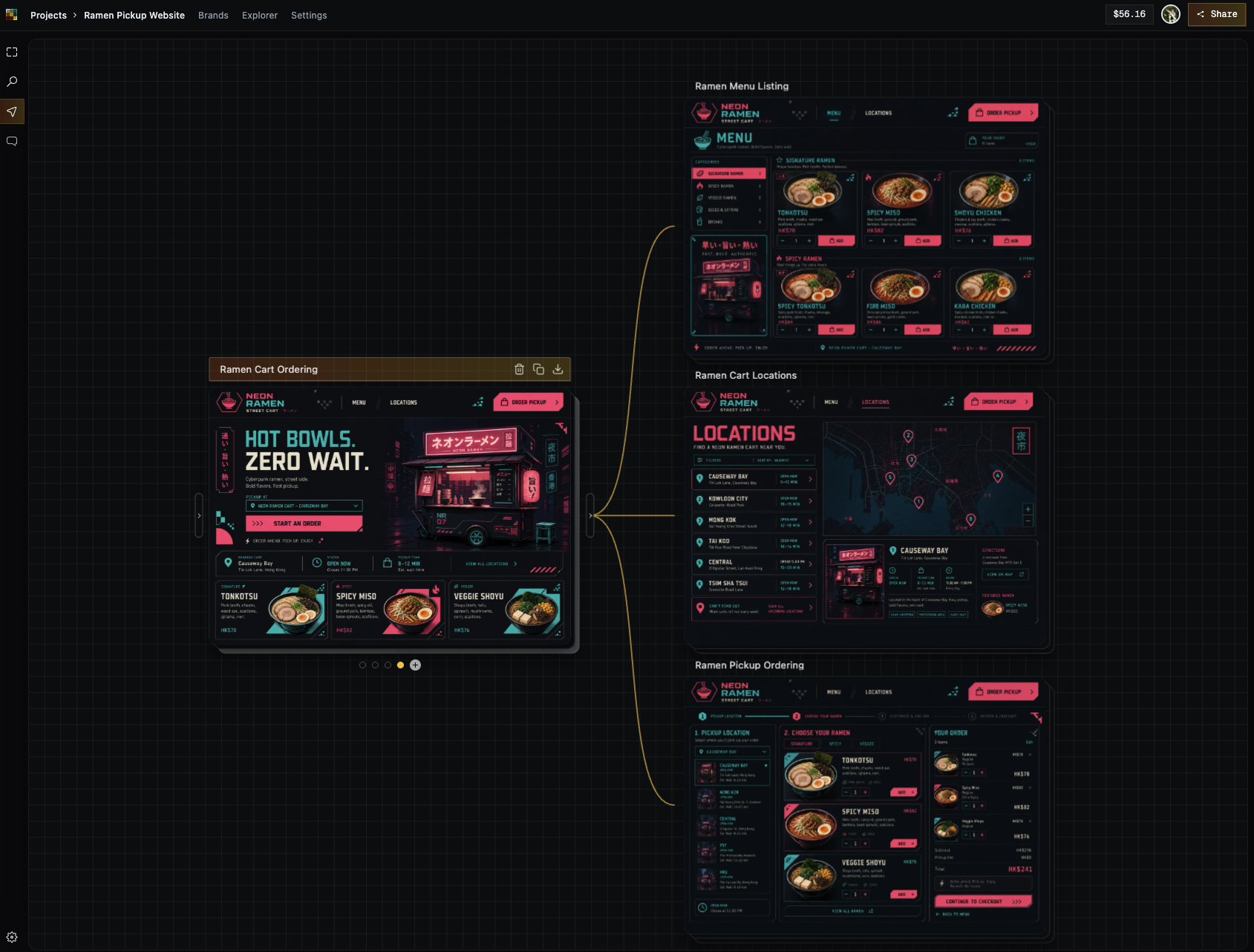
Here's another test of a cyberpunk ramen shop website.
One thing I've found LLMs have a lot of difficulty with is angular cuts / elements that aren't easily representable with CSS. Cyberpunk aesthetics are generally a great test of that, since they have a lot of microglyphs / window decoration.
Design source of truth: https://image.non.io/9d5fed20-b476-49d3-841b-37eb553fb88e.we...
Opus 5 build: https://html.non.io/neonRamen/
Thoughts: It does a really, REALLY good job at these angular cuts / microglyphs. The responsiveness is off, but I'm very impressed at how well it did here. One way I think of it is "how close to a finished product did this get me?". Opus gets you like 90% there.
Several other commenters have disparaging the design seemingly mostly due to its AI-generated nature, or maybe they actually do dislike cyberpunk.
Personally, I think being able to have these design languages be easily prototypable is fucking awesome. Great tests! (But a tad low-performance/janky, somehow). Though, I also like the cyberpunk aesthetic. Very on-brand(?) that AI generates it, hah.
God damn, we are living in the future.
I love this so much.
Designs like this would never have seen the light of day in the cellphone incrementalism / corporate memphis era of tech. Now people can be weird and awesome again.
This is 1980's cyberpunk / late-90's Matrix / early-00's sci-fi UI. Great ideas that died to frutiger aero (which isn't a bad design aesthetic) and flat design (which is).
This is fun and it's got great colors and I love it.
It's so refreshing to see this.
AI rules. This is the best timeline.
What do you mean designs like this? This is 2016-cyberpunk-neon-era inspired by video game interfaces, these are not uncommon at all. Google something like "discord cyberpunk theme" or "cyberpunk rice site:reddit.com/r/unixporn" and you'll find endless examples. This isn't suprising at all obviously.
I feel that AI has deeply diminished my ability to be weird and awesome, because my weird and awesome takes time and the results I can share with others are outshined by the machine.
Designs are here if you want to play with em: https://diffui.ai/app/canvas/68c5bb3d-467e-4841-b49d-c008e72...
This was just from a prompt "A cyberpunk themed ramen food cart website. Should feature menu, locations, and an ability to put in an order for pickup. Simple and clean website with angular cyberpunk microglyphs, pink/teal colors."
This comment resonated with me so much, and it seems to be a minority view (at least on this website).
I have found myself empowered by AI to tackle all sorts of things that would have too high of a barrier to entry for me to want to spend my limited time on as a busy father who is also working at a small startup.
And when I say that, I do NOT mean that I can crank out a bunch of slop and label it as something I produced even though I don't understand the code. I mean that I can do things like go back to college math that I never appreciated at the time and honestly felt too scared of. I mean having an on-demand math tutor that ask clarifying questions to as I struggle through the problem sets.
I have found that it actually accelerates learning how to code in various problem domains because I can tell it to answer my questions at a conceptual level and be a sounding board, but to never actually write code for me. It can review the code I write and gently nudge me without giving away the answers, so that I still struggle through the learning process and actually gain the knowledge.
And finally, for the first time in like 10 years of feeling overwhelmed and daunted by the prospect of learning game development (I have no background in that), I have found Codex to be an incredible boon for learning with the Godot engine. It helps me understand the terminology so that I know what to search for and what documentation to read. It helps me map my computer science knowledge from other domains into the game world, and to understand why things are structured the way they are. And because Godot saves all of the scenes and geometry and lighting and shaders to the file system as text files, Codex can inspect the results of the work I'm doing in the IDE and help me track down things I'm stuck on, and explain what the issue is. For example, why my pre-baked global illumination lightmap is breaking my ambient lighting configuration.
I know it has never been easier to cheat and skip the hard work that results in actually learning something, but for me, personally, I cannot believe the incredible value that $20 a month has provided me. I have never been more excited and eager to dive into tackling hard things I had previously been afraid of or simply too overwhelmed to attempt.
It has never been easier to quickly prototype and get a feel for some idea you have in your head to see if it even has legs. Simply seeing a quick prototype of an idea is often all of the excitement and fuel I need to then take it and make it a real project.
This is an awesome test! Thanks for sharing the results. Opus 5 is very impressive.
Out of curiosity, what app is that Design source of truth screenshot from?
That's from my own tool. I left figma to build a diffusion-based UI tool. Here's a show hn post with some more info: https://news.ycombinator.com/item?id=48995754
Edit: Generation was down, back up now. Apparently just hit my $1000 cap for the openai api. Upped it to 10k. Growth!
IMO a much better test would be designs that aren't AI to begin with. Much more useful to see how well a model can html an image design without slopping it up
I just clicked your links and then read your comment after - my first impression was the Fable version looks way nicer.
I agree the fable version looks nice - the rounded hero image for instance.
Opus though followed the source of truth better imo. The details are more present.
Fable filled in the gaps for things it wasn't able to do (ie in the design the hero image goes behind the nav), which resulted in a better looking page that was more divergent.
I liked the Opus version better if only because the responsiveness is less broken.
Same. I like the Fable version better. Better colors, better choice of font sizes, better column sizing. Also small things like the “Experience” section header being orange rather than gray, which Fable got right and Opus got wrong.
It seemed to me that Fable meaningfully improved on the original design more than just faithfully executing the original design.
This is cool, but I wish we could stop building landing pages to assess the intelligence of these models. There is much more to them than that. There are infinite number of complicated things that require a crap-ton of intelligence (biological or digital). The most fascinating of these for me these days is large scale migrations. Projects that are so ginormous and risky that many teams have either given up on them, or don't get funding. But with models like Opus, those projects are now within reach. What's MORE fascinating is that leadership is now asking if we can use opus models to get the refactor/migration done. This is the opposite of what has been happening for decades. Its so hard to make a convincing and affordable business case for large scale refactoring or migrations.
Looking at all these releases it’s not a surprise that model routing is the fastest growing segment in AI right now.
There are 10+ LLM companies, each with dozens of models of different modalities, each model with multiple size variants, then different “thinking” levels, then agentic modes, “pro” modes, a “fast” option, standard vs flex vs batch execution. And of course each end combination has a different input/output/cache token price.
Companies that say “give me a prompt and I’ll route it to the most ideal and cost effective model and setting for you” are capturing a ton of value from a gap that model developers don’t seem to understand exists.
Model Routing will always be done better by models themselves. Plus routing loses context making it more expensive and less reliable.
Model Routing is just Bitter lesson. The models themselves will get better at this and frontier companies will simply give that capability
This doesn’t seem obviously true, eg an Anthropic model will never route to Kimi even if it were best suited for a particular task.
I think what the parent is saying is that the model itself has the best context for whether a portion of a request should be routed. The specifics of that routing (e.g., should you route to KimiK2) are something that can be trained, finetuned, or even included in a model's startup context.
Has anyone tried that? I have a feeling that if I put it a prompt Claude would comply. But I am all in on the Claude cool aid.
Why should it? An Anthropic model is architecturally optimized for Anthropic models, routing it to Kimi makes zero sense
[dead]
i think you're thinking of subagent routing
model routing in this case is cross-provider
Imo the main issue behind model routing is you need to figure out how much intelligence a new task takes, which is a very non trivial problem. Presumably, a organization knows this about their own tasks and is better suited to built in-house compared to outsourcing to a vendor.
Model routing by the model itself requires the model to pull in a lot of context and it's likely more efficiently just done by people with the context already in their head, even assuming the model is perfect at routing (which last I checked, Claude definitely isn't). I wouldn't trust ML model routers.
Because they're trying very hard not to understand it.
Otherwise the expensive-yet-powerful model probably won't see much revenue. How much money is there in bleeding edge scientific research? There's a lot, but there's even more existing capital in paying people people to do college level paperwork, and the bulk of those traffic gets routed to the cheapest model.
You mostly don't need super powerful AGI to replace the paper pushers, but the frontier labs are trying to position themselves as being uniquely capable of producing super powerful AGI, and also be the ones replacing office workers.
Not sure how it will work out for them, but I think model routing is going to poke holes in that narrative. That's why I think they're trying very hard not to understand model routing exists.
It wasn’t long ago at all that the chief problem was “can AI even help me with this” (cost be damned). Until a time when the answer is an unmitigated “yes, obviously”, the frontier labs have everything to lose and nothing to gain on routing, because if they screw it up you might incorrectly decide “nope, it can’t help yet” due to a poor routing decision.
Who are the customers though? Honest question, I'd like to understand it.
For me, anything other than current best available SOTA for any task is unacceptable. The only routing rule I need is "the most powerful model I still have flat-priced quota available for". I mean, why settle for less?
There are two types of users: those who are able to use subsidized rates, and those who need to use API rates due to audit requirements, enterprise billing, etc.
Model routing for subsidized users takes the form of a "use Opus 5 subagents for implementation" type of system prompt. You lean into a single provider, build tooling around that, and your savings are far beyond anything multi-provider routing can get you.
Model routing for enterprises is far more complex - approaches like https://fireworks.ai/blog/kimik3-fable become necessary for cost control.
on top of that there is also additional factor: speed - sometimes if task is easy you do care to finish it faster.
There is also matter about convenience - when I ask some small easy question often I don't bother to switch the model or forget in prompt to ask faster/cheaper subagent.
It's very common to use a lesser model for a lesser task, resulting in same quality output. End result: save money while being faster. In many cases, it's a pure win-win.
But in other many cases you have to redo the work directly or indirectly, and you are more expensive (for now) than even the most expensive models, so sounds like a total lose.
I’m assuming you don’t pay per API call. Every mid-large sized business in the world does.
And you do not have flat priced quota for Fable 5, right? Because nobody has, as far as I know. So you'll probably not route any task to the "current best available SOTA".
Also: quota. Implies you do not have unlimited access even for flat prices. Which in turn implies that as soon as you hit the quota on the most expensive flat price plan, even you will suddenly discover the magic of economically sensible behavior.
Fable 5 is included in the Claude Max subscription. I've gotten close to the limits this week and last but haven't hit it yet.
I am not convinced this will end up being a domain of the ‘routers’ vs the clients, as in harnesses themselves. Thoughts?
https://www.anthropic.com/news/claude-opus-5 - A blog post for those not wanting to go through a 190ish page pdf
I like how they highlighted Opus 5 as the best for “Agentic Coding” even though the number is slightly lower than Fable. Close enough for marketing, I guess!
At half the price and less likely to auto-downgrade, it sounds like a reasonable claim.
> At half the price and less likely to auto-downgrade, it sounds like a reasonable claim
Two benchmarks (artificial analysis and vals) show a increase in cost (a insane increase for vals compared to Opus 4.8).
Already posted this before, so here is the link.
given that i couldn't even use fable without it downgrading to Opus, this is just a straight upgrade for me
Best can describe multiple things.
Almost as good for half the cost is something I'm very comfortable describing that way.
> Almost as good for half the cost is something I'm very comfortable describing that way.
It's also not unusual in this context - many people describe the Chinese models as "best", because it's 80% as good for 20% of the price (or similar).
Best marketing
The blog posts figure cites Frontier-Bench for its agentic coding score, and shows Opus 5 beating Fable 5 43.3% to 33.7%.
I think you're being overly cynical here. First, I don't see any claim that is the world's best model for agentic coding. Second, it is absolutely the best model in terms of coding performance vs. dollar, and it's raw performance seems very close to the frontier.
GPT 5.6 is far more token efficient at most tasks with similar performance. Especially so for Opus 4.8, still to be seen with Opus 5.
Where are you getting cheaper per dollar?
It would still be the best model per dollar if the score was 2% lower instead of 0.1% lower. Would it be ok to still give it the highlight color then?
How big of a lie is too big? Especially when no lie needed to be told at all: many including myself would have noticed the tiny 0.1% deficit and been suitably impressed by the Opus 5 result.
I’ll admit this is a small deception by today’s standards. I’m one of those who believes in truth for truth’s sake.
Edit: typo
Thanks for that, looks really good. I can see why they were constantly pushing back fable going out of the max sub with these benchmarks
I wonder why FrontierCodev1.1's data lists Opus 5 as better than Fable 5.
this feels like the perfect example of an LLM producing a long text document. And end users just using an LLM to summarize it without actually reading it
I compared the writing style of Opus 5 vs Fable 5, and Opus 5 continues many of the "Claude-isms" of its 4.8 predecessor in a way that Fable broke away from.
Opus 5 still uses "carry the argument", "worth stating plainly", ", and the trap", "The X matters more", the use of "move"
We need an "annoying English" benchmark.
- Fable 5 Max: https://gist.github.com/deet/3d97f854b48eac6658d642fa18bb24d...
- Opus 5 Max: https://gist.github.com/deet/1a43693a732dfccb4d0d914bfc42692...
Fable might be using those phrases less, but its writing is still terrible and exhausting to read.
Agreed. I’ve interestingly found 5.6 sol to produce much better writing, and it can generally cut to the point much more effectively.
Could these complex/hard to read Fable outputs be sign of some kind of industrial level of intelligence, which us humans may have a hard to comprehend, while it may be also hard for machine to use simpler texts to properly outline all nuances and complexities of concepts it output?
Fable subagents communicate very effectively with one another, so this would be a reasonable take imo
I think a signature Claude style of writing is good since it makes it that much harder to pass off Claude written text as human.
I found 4.6 more amenable than 4.8 to style directions, we'll see how 5.0 does. Super-small-sample-size: I think part of its "Claude-ism" style comes from its propensity to try and "proactively" move the conversation/work along. Not sure how this would fare in non-obviously-productive environments, I'd guess "it's still annoying" considering your evidence.
I'm also thinking of another benchmark: (quantified) stylistic range across different prompts. Just putting it out there if anyone wants to do the work for me :D
I’m pretty sure Opus 5 is adapted to tricks from long reasoning in Kimi K3 and based on original Opus 4.8. It is not fable in any form.
Seems unlikely they adapted anything from K3 given the timeline of releases, similar to how K3 was obviously not distilled from fable
Edit: It was pointed out to me that Opus 4.8 got "21%" for successfully fully completing ~1-in-5 tasks, but also got "55.7%" for obtaining significant partial credit on some of the ~4-in-5 tasks it could not fully complete.
---------------
Why does Anthropic say here that Opus 4.8 scored 55.7% on OSWorld 2.0 benchmark, but the paper published by the authors of OSWorld 2.0 say they achieved a benchmark of ~21% with Opus 4.8? [0]
That's a huge gap, considering that the paper was published just 2-4 weeks ago.
I understand that the benchmark authors have an incentive to publish lower numbers (to show that the benchmark has potential longevity) and that Anthropic has incentive to publish higher numbers, but the other models seem pretty inflated as well. The benchmark authors shows GPT-5.5 at 14%, and Anthropic shows GPT-5.6 Sol at 62.6%.
Is there any reasonable explanation for this? Do all the other benchmark numbers need to be sanity-checked as well? Are SOTA benchmarks really this difficult to get consistent, replicable results within a reasonable range of tolerance/variability? Can these benchmarks be compared from one paper to another, or are they only valid to compare intra-paper results?
You're comparing the "score percentage" (e.g. out of the total number of partial points available, how many did the agent achieve) to the "completion percentage" (how many tasks does the model score 100% on). The paper says "Claude Opus 4.8 with maximum thinking and batched tool calls scores best but still completes only 20.6% of tasks at a 54.8% partial score", which is ~the same number that Anthropic reports here (55.7 vs 54.8).
That is—the agent scored 100% on 20% of tasks, but on average it got 54% of the "score" awarded in the exam. One number reflects partial progress, the other one doesn't. The authors of the benchmark prefer you to look at the lower number (because they want to show their benchmark as capturing useful gaps in capabilities and with a lot of room for improvement), the authors of the models want you to look at the higher number (because they want you to think of their models as capable)
In what world is 55.7 the same number as 54.8?
What variance is acceptable to publish without a retraction?
That seems like entirely reasonable variance to me for AI models. For my purposes, that absolutely counts as a solid "replication". I'd probably accept +/- 5 percentage points even.
There is randomness in LLMs. Both papers authors probably ran the bench 1-N times. Depending on that, they might select an average, max, least, etc. They might also have discarded outliers.
Like the other person said 5% variation is probably expected
I don't know who downvoted the parent or why, but it's a fair question IMHO.
The answer is there can be dramatic difference running a benchmark one time, because LLMs are not deterministic. A proper methodology would ask each question 20 times and calculate the mean correctness across experiments.
The reason is that the temperature parameter introduces random behavior.
[flagged]
Its slop all the way down.
Their communication is confusing. They say "Opus 5 is not more capable overall than Fable 5", but their blog post proceeds to list how much better Opus 5 is than Fable 5 on __most__ benchmarks listed.
Then system card goes on to "Its AI R&D capabilities are comparable to those of Claude Mythos 5", which is supposed to be fable minus restrictions.
It seems they are trying to thread a needle here - they want to say it's very strong, but apparently this time do not want to invite extra government scrutiny.
They do say that (implicitly unlike Mythos) Opus 5 was not trained to exploit software vulnerabilities, which would certainly make it safer in that regard.
"As with its predecessor, Opus 4.8, we’ve intentionally avoided training Opus 5 on cyber tasks. The model has nevertheless improved substantially on these tasks as a result of becoming more generally capable, and it comes close to Mythos 5 at finding cybersecurity vulnerabilities. However, it remains substantially behind Mythos 5 on the exploitation of those vulnerabilities—that is, in turning vulnerabilities into material cyber threats."
Easy enough to explain: they're benchmaxxing. Fable is intelligent but not benchmaxxed. Opus is less intelligent but benchmaxxed.
That's a plausible explanation but I'm not seeing evidence for it.
I have a personal benchmark suite of 14 real, non-public tasks. Opus 5 and Fable tied on 10, Opus won on 3, and Fable won on 1. It's a really strong model.
Yep , same with 5.6. Fable is still the best.
But still nerfed compared to the initial release.
Honestly that's the simplest explanation and thus likely the correct one.
Capable in term of AI R&D, not capable in terms of hacking (which caused all the Fable drama.) But agree, confusing wording.
Maybe they don't want to say that to avoid the government scrutiny.
Get a daily email with the the top stories from Hacker News. No spam, unsubscribe at any time.